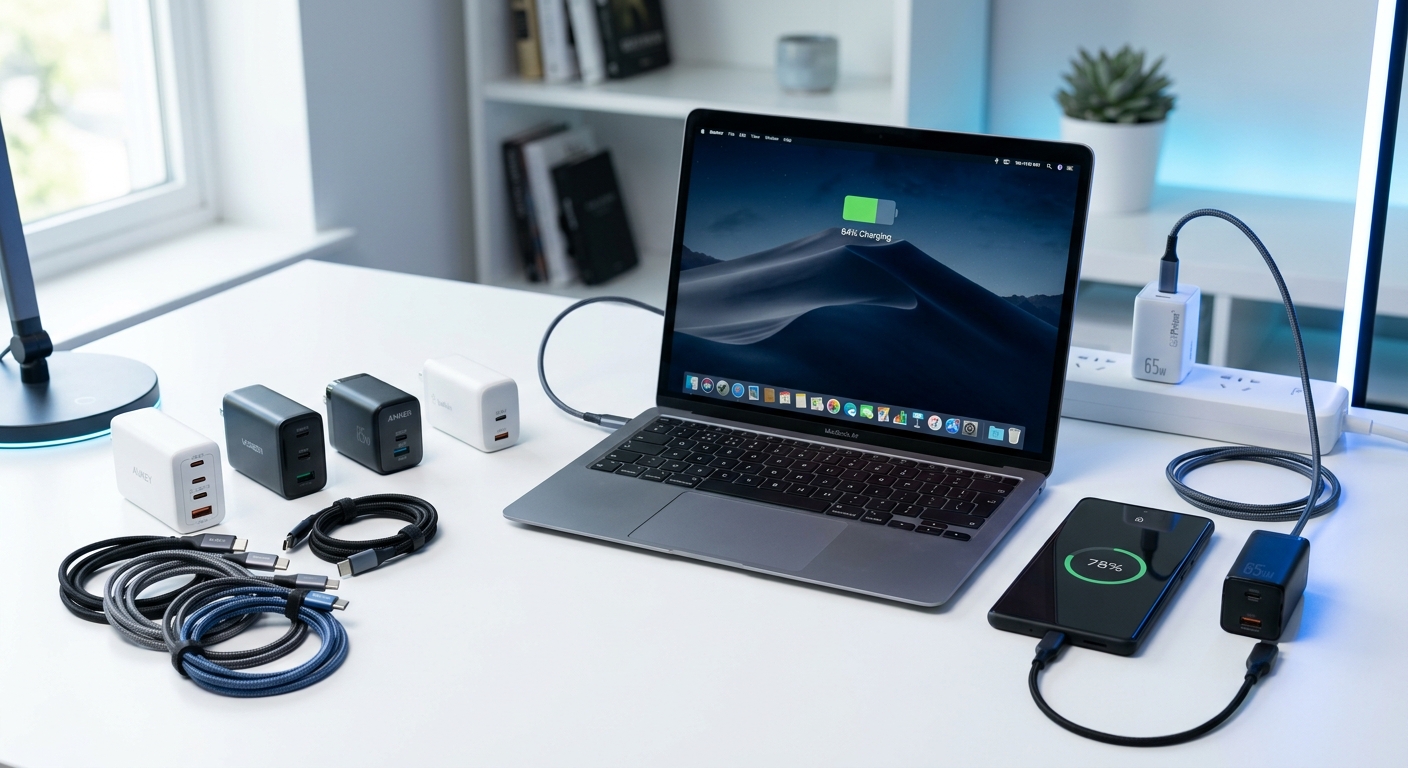
Fast Charging Explained: Choosing the Right Charger for Every Device
Fast charging is one of the most useful tech features of the past decade, but the marketing is confusing. Different standards, wattage ratings, and connector types make it hard to know what to buy. This guide breaks down everything you need to choose the right charger for every device.
Table of Contents
- Understanding Charging Standards
- USB-C Power Delivery (PD)
- GaN Technology Explained
- Wireless Charging (Qi)
- Matching Wattage to Devices
- Multi-Port Chargers
- Car Chargers
- Power Banks
1. Understanding Charging Standards
Fast charging is not a single technology. It is a collection of protocols that negotiate power delivery between charger and device. The main standards are USB Power Delivery (PD), Qualcomm Quick Charge, and proprietary protocols from Apple, Samsung, and OnePlus.
The good news: USB-C PD has become the universal standard. Most devices released after 2020 support PD, meaning one charger can power your phone, tablet, and laptop.
2. USB-C Power Delivery (PD)
USB-C PD can deliver up to 240W of power, enough for high-performance laptops. The protocol negotiates voltage and current dynamically — a phone might request 9V/2A (18W) while a laptop requests 20V/5A (100W) from the same charger.
Key point: the charger must support the wattage your device needs. A 20W charger will charge a phone quickly but will not power a laptop that requires 65W. Always check your device power requirements before buying a charger.
3. GaN Technology Explained
Gallium Nitride (GaN) is a semiconductor material that is more efficient than traditional silicon. GaN chargers run cooler, are smaller, and can deliver more power in a compact form factor. A 100W GaN charger is roughly half the size of an equivalent silicon charger.
GaN chargers cost slightly more but the size and weight savings are significant, especially for travel. A 65W GaN charger with 3 ports can replace three separate chargers and fit in a jacket pocket.
4. Wireless Charging (Qi)
Qi wireless charging uses electromagnetic induction to transfer power without a cable. Standard Qi delivers 5-15W, which is slower than wired charging but convenient for overnight charging or desk use.
MagSafe (Apple) and similar magnetic alignment systems improve efficiency by ensuring perfect coil alignment. This reduces energy waste and heat generation, making wireless charging more practical for daily use.
Limitation: wireless charging is inherently less efficient than wired charging, losing 20-30% of energy as heat. For fast charging, always use a cable.
5. Matching Wattage to Devices
Here is a practical guide to wattage requirements:
- Phones: 18-30W for fast charging (0-50% in 30 minutes)
- Tablets: 30-45W for reasonable charging speed
- Ultrabooks: 45-65W for full-speed charging
- Performance laptops: 65-100W (check manufacturer spec)
- Large laptops / workstations: 100-140W
Using a higher-wattage charger than needed is safe — the device only draws what it requires. Using a lower-wattage charger will charge slowly or may not charge at all under load.
6. Multi-Port Chargers
Multi-port chargers are the most practical solution for people with multiple devices. A 100W GaN charger with 3 USB-C ports can charge a laptop, phone, and earbuds simultaneously.
Important: total power is shared across ports. A 100W charger with 3 ports might deliver 100W to one device, or 60W + 20W + 20W to three devices. Check the power distribution table in the product specifications.
7. Car Chargers
Car chargers plug into the 12V accessory socket and typically deliver 18-30W per port. Look for models with USB-C PD for modern devices. Dual-port car chargers let you charge two devices simultaneously, which is essential for family road trips.
Wireless car chargers combine a phone mount with Qi charging. They are convenient for navigation but charge slowly (10-15W) and may struggle to keep up with GPS power drain on hot days.
8. Power Banks
Power banks provide portable charging when outlets are not available. Key specifications: capacity (mAh), output wattage, and weight. A 10,000mAh power bank provides roughly 1.5-2 full phone charges and weighs 200-250g.
For laptop charging, look for power banks with 65W+ PD output and 20,000mAh+ capacity. These are heavier (400-500g) but can extend laptop runtime by 2-4 hours.
Conclusion
The right charger depends on your devices and lifestyle. For most people, a single 65W GaN charger with 2-3 ports covers all daily charging needs. Add a 10,000mAh power bank for travel and a 15W wireless pad for overnight phone charging. Total investment: $60-100 for a complete charging setup that handles every device you own.
FAQ
Can I use a laptop charger for my phone?
Yes. USB-C PD negotiates power delivery, so a 65W laptop charger will safely charge a phone at the phone maximum rate (typically 18-30W). The phone only draws what it needs.
Is fast charging bad for battery health?
Modern fast charging protocols manage heat and voltage to minimize battery wear. The impact on battery lifespan is minimal (5-10% faster capacity loss over 2 years). The convenience of fast charging outweighs this small trade-off for most users.
Are GaN chargers worth the extra cost?
Yes, especially for chargers above 45W. GaN chargers are significantly smaller, run cooler, and last longer than silicon chargers. The $5-10 price difference is justified by the size and weight savings alone.